
Storefront filter URLs now use stable identifiers – what’s the SEO impact?
Shopify has introduced a small but important update to how storefront filter URLs are generated. Instead of using human-readable values like colors or sizes, filter parameters now rely on stable identifiers. You can see the official announcement here.
Updated: 25.4.2026
What changed in filter URLs?
Previously, filtered URLs often included readable values, for example:
/collections/shoes?color=red
With the new approach, the same filter might look like this:
/collections/all?filter.v.option.color=gid://shopify/FilterSettingGroup/456
Instead of “red”, Shopify now uses an internal identifier that remains stable over time.
Are all filters affected?
Not really. This change does not apply to all filters, only to specific types.
In practice, it mainly affects:
- Variant and product options – standard variants like color, size, or material
- Metafield-based filters with predefined values, usually including metafield types like
list.single_line_text_fieldorlist.metaobject_reference
If you’re using these types of filters, their URLs will now use stable identifiers instead of readable values.
Some filters still use readable values and remain unchanged. Typical examples include:
- Product tags
- Product types
- Vendor
- Availability
- Price
These filters will continue to use their original structure, for example filter.p.tag=new.
Why Shopify made this change
Filter values don’t always stay the same. Merchants frequently rename them, adjust wording, or translate them into different languages.
In the previous setup, even a small change like renaming “Red” to “Rouge” could result in a completely new URL. Over time, this could create multiple versions of essentially the same filtered page.
By switching to stable identifiers, Shopify ensures that URLs stay consistent regardless of how filter labels are edited in the admin.
What does this mean for SEO?
The biggest SEO impact is not the URL format itself, but how Shopify handles existing filter URLs.
In the official Shopify changelog, it is explicitly stated:
“Please note that all former storefront filter URLs you have created will continue to work as expected.” See the screenshot below:
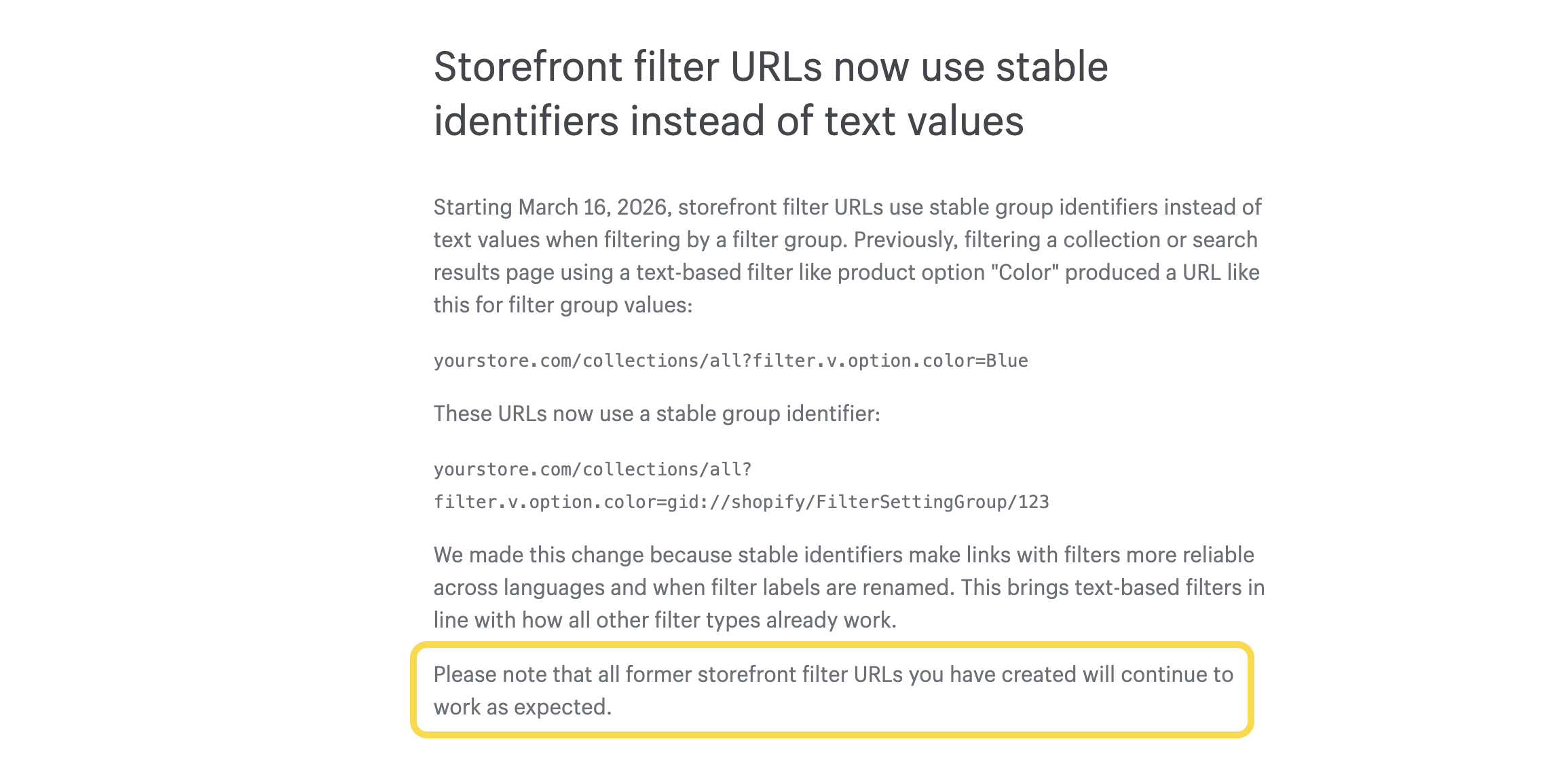
This is an important detail. It means that older, text-based filter URLs should still resolve correctly and not result in soft 404 errors.
However, Shopify does not mention automatic redirects to the new identifier-based URLs. In practice, this likely means that both URL versions can coexist — the old readable ones and the new ones using identifiers.
From an SEO perspective, this introduces a different kind of challenge.
Instead of broken pages, the main risk is URL duplication. The same filtered content may be accessible under multiple URL formats, which can:
- Split ranking signals
- Create duplicate content scenarios
- Make it less clear which version should be indexed
Compared to this, the loss of keyword-rich URLs (like “red” in the URL) is relatively minor. While those keywords did provide a small relevance signal, they were never a strong ranking factor.
On the positive side, the new system improves long-term consistency. Stable identifiers prevent URL changes when filter values are edited, which helps avoid future fragmentation.
How to approach filtered URLs now
This update doesn’t change the overall SEO strategy for filtered pages — but it makes reviewing your setup more important.
If filter URLs were previously indexed or used externally, it’s worth checking whether they still work as expected. In some cases, you may need to handle redirects manually or simply accept that those URLs should no longer be used.
In general, filtered pages are still not ideal for SEO. They tend to create large numbers of similar URLs and can complicate crawling and indexing.
A safer approach is to keep filtered URLs either canonicalized to the main collection or excluded from indexing. If you want to target specific queries (like “red sneakers”), it’s still better to create a dedicated collection page for it and optimize it properly.
What’s the key takeaway?
To sum up, Shopify’s move to stable identifiers improves consistency and prevents unnecessary URL changes in the future.
While Shopify states that existing filter URLs will continue to work, the lack of automatic redirects to the new format can still be a downside.
It may lead to multiple URL versions of the same content, which can result in duplicate pages, diluted ranking signals, and in some edge cases even unexpected behavior or even broken filter states. If not monitored, this can impact both SEO performance and user experience.
For most stores, the takeaway is simple: review any previously indexed filter URLs, monitor for duplicate content and soft 404s (if any occur), and continue focusing your SEO efforts on well-optimized collection pages rather than filtered results.
And that’s it! If you have any questions about the new filter URLs, let us know–we’re happy to help.